Peter Jackson’s Lord of the Rings trilogy remains an uncontested champion in several fields — from holding the record for most Academy Awards to setting new standards for high fantasy storytelling. The original movies were so perfect that the subsequent Hobbit prequels could barely hold a candle to them, despite also being directed by Jackson. And then came Amazon’s Rings of Power, a television adaptation set to chronicle the most important events during the Second Age of Middle-earth. In fact, the rights for the series were acquired at a previously unheard-of price: $1 billion for five seasons.
When the first season rolled around, however, The Rings of Power was beset by criticisms and complaints. Vote brigading may have led to a deterioration in Rotten Tomatoes’ Popcornmeter score, but there were also justifiable issues with storytelling, pacing, and timeline. Season 2 saw a slight improvement in the audience-rated Popcornmeter, while the Tomatometer scores for both seasons currently sit at a decent 84%. Now that Season 3 has been confirmed — with a notable writers’ room change and a significant time-jump — fans are eager to see if The Rings of Power can finally redeem itself.
The Rings of Power Was Criticized for Valid Reasons
Image via Amazon Prime Video
Claims of authenticity have been used by several fandoms when judging a television or movie adaptation of their favorite novels. Robert Jordan’s Wheel of Time, Stephen King’s The Dark Tower, and even Christopher Paolini’s Eragon were criticized for not being flawlessly true to the source material. While critics offered The Rings of Power a decent overall rating, many among the Lord of the Rings fandom found the first season lacking. Numerous complaints were raised: some of them focused on the show’s overall quality, citing the atonal atmosphere and discordant pacing, whereas others blamed the cultural zeitgeist for the series’ perceived “wokeness.” The so-called diehard fans didn’t necessarily share the same sentiments as the general TV audience, though, which is why Season 2 was better received.
Casting POC actors in roles not designed for them isn’t the end of the world — on the contrary, diversity has a habit of enriching any story, especially fictional ones where countless non-human races exist. And yet, Arondir’s actor, Ismael Cruz Córdova, received “pure and vicious hate speech” in his messages for two years after he played a non-lily white Elf in Rings of Power. The severe backlash prompted three of the original trilogy’s Hobbit stars — Dominic Monaghan, Billy Boyd, and Elijah Wood — to actively champion diversity within Tolkien’s world. The Lord of the Rings and its associated books were written at a different time and designed for a limited audience; even Tolkien couldn’t have predicted that his novels would become globally renowned on such a grand scale.
Aside from evaluations based on pointless bigotry, The Rings of Power was justifiably slammed by fans and critics alike. Season 1 had far too many unrelated storylines simultaneously stretched across various episodes, and some of them had less weight than others. Elrond and Durin’s friendship was well-received because it harked back to Elrond-Gimli, whereas the arrival of Gandalf and his initially befuddled personality strayed too far away from Tolkien. Likewise, the Númenórean arcs were steeped in resplendence and beauty, faithful to the books, but their politics were artificial and simplified into cumbersome expositions.
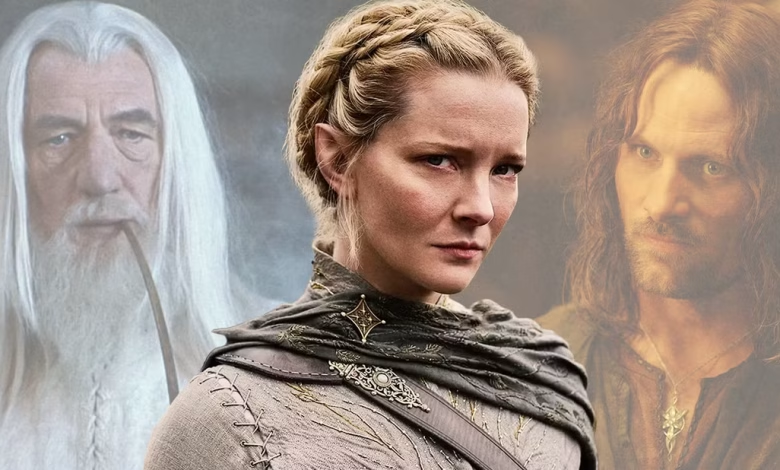
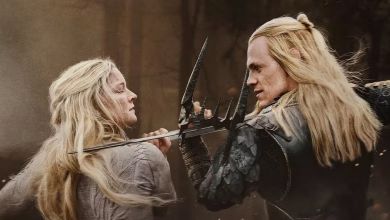
Season 1’s most controversial moment was undoubtedly the reveal of Sauron. A few fans had already predicted that Halbrand would be unmasked as the Dark Lord of Middle-earth, but the vast majority were shocked by the discovery. In a related vein, Galadriel’s warrior-like portrayal was completely non-canonical, painting her as a belligerent swordswoman when the novel character never quite fought in battle. That said, both versions of Galadriel were hot-headed in their youths, and The Rings of Power found an interesting way to showcase that aspect of her personality. Watching Galadriel and Halbrand/Sauron interacting was yet another criticized addition, but The Hobbit movies did the same thing by having Galadriel chase the Necromancer away from Dol Guldur, which never happened. With Apple TV+’s Foundation as an example, sometimes the canon must be expanded.
The Rings of Power Bears the Unfair Weight of LOTR’s Legacy
Image via New Line Cinema
A billion dollars for a TV series, even spread across five seasons, would give each season of The Rings of Power an approximate production budget of $150+ million. This was around the same as House of the Dragon, which has seemingly surpassed The Rings of Power in all matters of quality. The problem, at least partly, lies in the fandom’s expectations. When the monumental triumph of Game of Thrones collapsed in its final season, viewers weren’t really expecting much from the prequel, let alone hoping that it would be an improvement. In the span of two seasons, House of the Dragon turned out to be a breath of fresh air with a looming legacy of its own.
In comparison, The Rings of Power had to live up to The Lord of the Rings and its 17 Oscars, not to mention a legacy that has only improved in the 20+ years since. The practical and visual effects hold up, the heroes are still endearing, and Jackson’s creativity ultimately paired perfectly with Tolkien’s vision. In fact, the critically mediocre Hobbit trilogy should have been a sign that things may not get better. The Lord of the Rings defined an era; The Rings of Power was just supplementary material transformed into a passable narrative. As a result, the show’s visual vocabulary failed to capture the movie trilogy’s cinematic grandeur, not even with such a high budget.
It is also important to note that Jackson’s trilogy was already written in the form of a story, not to mention one of the greatest stories of the 20th century. Adapting the books was arguably an easier job, given Tolkien’s pre-structured storyline — all the director had to do was add or remove scenes. Meanwhile, the multi-narrative in The Rings of Power was sourced from fragments of stories scattered across the Tolkien legendarium. The show needed to stitch together events from The Silmarillion, Unfinished Tales, and the twelve-volume series known as The History of Middle-earth. Tolkien had only created a basic connective framework between his many, many stories, forcing the shows to incorporate their own padding.
Fans basking in the glory of The Lord of the Rings expected The Rings of Power to be just as brilliant and unique, or be nothing. This binary expectation refuted the need for slow pacing and gentle thematic layering, which the series couldn’t do without. Mythic solutions aren’t always the answer — Amazon’s Rings of Power is an examination of choices through the lenses of power and time, and Tolkien’s world comes with thousands of years of history. It must be admitted that the time frames in the series felt unnecessarily confusing, what with so many events occurring within a small duration, but that’s yet another side-effect of compressing storylines for adaptations. If allowed, The Rings of Power could harness its own success for an overarching slow-burn that surely succeeds in the end.
The Time Jump Before Season 3 Could Fix the Problems
Image via Amazon Prime Video
Season 1’s writers worked hard to make the show as Tolkienian as possible, even if they had to throw in new characters as well as new backstories for existing ones. Some fans hated the creation of Mordor and Mount Doom, supposedly created by the First Dark Lord Morgoth during the First Age, as the show revealed a different origin story. Hobbits and Wizards were included because of their popularity in The Lord of the Rings and The Hobbit trilogies, and the ore of mithril is given a unique power it never had in the novels. Season 1’s failure stemmed mainly from its weak character development, a mistake that was somewhat rectified later.
Season 2’s writers shifted the focus onto the villains, from Adar to Sauron, while simultaneously exploring Tolkien lore and iconic characters like Tom Bombadil. Celebrimbor’s decaying relationship with Sauron formed the basis for the second season, as fans watched the Elf lord slowly lose his mind before losing his entire kingdom. And Sauron played all sides until he got what he wanted — he misled Adar and the Orcs into attacking Eregion, forced Celebrimbor to craft the nine rings, and finally stole them from Galadriel. The Fall of Eregion ended Season 2, a devastating blow for the heroes that’s certain to ripple outwards.
With a few exceptions, the writers’ room for The Rings of Power Season 3 has been given fresh faces and voices, which fans are hoping will translate into superior storytelling. The logline also claims that the third season jumps “forward several years from the events of Season 2,” a great opportunity to improve the show. In this duration, characters like Galadriel, Elrond, and Durin can be empowered by off-screen character growths, the narrative can be streamlined, new characters can be added, and the stakes can be raised higher than ever before.
In the source material, the Fall of Eregion marks the beginning of the Dark Years of Sauron. These continue until his ultimate destruction at the War of the Last Alliance, which implies that the remaining three seasons will be set in this era of the Second Age. Stories as vast in scope as The Rings of Power cannot be digested without skipping the years where nothing significant happens. Tolkien himself used time-jumps to great effect, like the 17-year span between Frodo inheriting the One Ring and setting out to Mordor. The only question is the span of the time: a couple of years would make little difference, but a few decades of narrative vacuum — partially revealed in flashbacks — can be just what The Rings of Power needs to find its place.