I’ll admit, I have some bias here. I have enjoyed Rings of Power. It’s not the best TV show I have ever seen, and it’s certainly not my favorite adaptation of J.R.R. Tolkien’s works. Still, I find Rings of Power to be visually breathtaking and a good deal of fun. I’ve also been deeply critical of some of the silliest ways that the Prime Video series has gone wrong. However, I’ve yet to find it blasphemous.
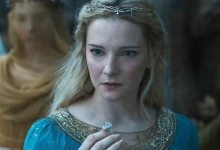
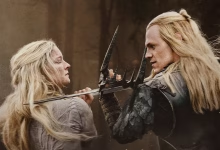
To hear many tell it, Tolkien would be in a rage if he were alive to see Rings of Power. This would be in response to, according to them, the presentation of Galadriel as a warrior, the confused timeline, the skin color of the characters, and even the existence of baby orcs. From these viewers’ point of view, Tolkien would demand changes, or wish the show taken straight off the air.
We Can’t Know For Certain What JRR Tolkien Would Think Of Any Modern Lord Of The Rings Adaptation

It’s important to note that any discussion about how Tolkien would feel about Lord of the Rings adaptations is pure speculation. The author expressed himself rather clearly through hundreds of now-published letters, and these are often used to support one side or the other (and I will do the same). However, we can’t ignore that these letters don’t directly relate to modern adaptations.
All the same, Tolkien willingly sold the screen rights for Lord of the Rings. This was famously done out of financial necessity, and, shortly after, Tolkien expressed his belief that no film could do his story justice. He was right, of course. Even today, Hollywood magic can’t quite cut it. However, even knowing that the screen would vulgarize The Lord of the Rings, Tolkien was willing to see what others would do with his art.
“As far as I am concerned personally, I should welcome the idea of an animated motion picture, with all the risk of vulgarization; and that quite apart from the glint of money, though on the brink of retirement that is not an unpleasant possibility. I think I should find vulgarization less painful than the sillification achieved by the B.B.C.” – J.R.R. Tolkein, Letter #198, 1957
JRR Tolkien Had A Golden Rule For Screen Adaptations (& Rings Of Power Passes The Test)

Tolkien’s general attitude toward art, even that which he didn’t like and openly criticized, indicates that the author wouldn’t feel the same sort of venom toward The Rings of Power as many seem to think. However, another big question is whether Tolkien would wish that Rings of Power did not exist at all. Though the author can’t say for himself now, we have some pretty clear signs that he wouldn’t.
Tolkien and his lawyer agreed on a rule regarding Lord of the Rings adaptations. They referred to it as “Art or Cash,” and Tolkien described this rule in a letter to his son, Christopher Tolkien, and daughter-in-law, Faith Tolkien. He explained that an adaptation must have “either very profitable terms indeed; or absolute author’s veto on objectionable features or alterations.“
For better or worse, Rings of Power follows this rule. Prime Video is under contract with the Tolkien estate for five seasons and 50 episodes, and the company has already paid out millions for its existing two seasons. Even if Rings of Power were to be canceled, it would have to pay $20 million for each unmade season. This ensures that Tolkien’s estate gets its dues, even if Prime Video’s creative liberties mess the project up—just as Tolkien designed.
Why There Is So Much Misconception About Tolkien’s Views On Lord Of The Rings Adaptations

Tolkien’s “Art or Cash” rule means that he likely would have allowed Rings of Power to be made if he were alive today, just as his estate is doing. He understood that art is art, and he himself opened the door to people taking his own creation and making it theirs. Still, we know that just because Tolkien respected this process doesn’t mean he wouldn’t have criticized it.
There were several potential Lord of the Rings movies that had gotten the ball rolling but ultimately fell through, and Tolkien weighs in on some of these projects in his letters. Of one, he praised the imagery and creativity used to capture the glorious landscapes of Middle-earth, but criticized the nonsensical way that the story was approached:
“An abridgement by selection with some good picture-work would be pleasant, & perhaps worth a good deal in publicity; but the present script is rather a compression with resultant over-crowding and confusion, blurring of climaxes, and general degradation: a pull-back towards more conventional ‘fairy-stories’. People gallop about on Eagles at the least provocation; Lórien becomes a fairy-castle with ‘delicate minarets’, and all that sort of thing.” – J.R.R. Tolkien, Letter #201, 1957
Tolkien could almost be talking about Rings of Power here. The author put a great deal of thought into his work, and it’s evident in his letters that he would become frustrated when he saw other creatives taking a lazier route. This has, understandably, inspired many to take up arms in support of Tolkien’s work. Nothing will ever be as good as his books.
However, it’s important to note that Tolkien was critical, but not hateful. As an academic, he was always in a place of analysis and criticism, both for his own work and that of his peers. Rings of Power isn’t perfect, and Tolkien surely would have had words to say about it. However, to say he would hate it and is rolling in his grave doesn’t align with what we know of this author’s perspective on art.