The third season of Prime Video’s The Lord of the Rings: The Rings of Power is currently in production. The end of the second season set up some exciting plot threads for the future, including the War of the Elves and Sauron, the distribution of the Nine Rings, the arrival of Durin VI’s brother, and Gandalf’s conflict with the enigmatic Dark Wizard. Up to this point, The Rings of Power‘s timeline has only vaguely followed that of J. R. R. Tolkien’s novels. The 3,441 years that made up the Second Age of Middle-earth have been condensed into a nebulous time frame, simplifying the story and eliminating the need to age up the cast of non-immortal characters, such as Theo and the other Southlanders.
Some key moments from the Second Age have also been rearranged. For example, the second season ended with the siege of Eregion, which was preceded in Tolkien’s lore by the Dark Lord Sauron forging the One Ring, an event that has yet to occur in The Rings of Power. There is reason to believe that something similar will take place in the upcoming season. One of the most important events of the Second Age was the Downfall of Númenor, in which the island kingdom was swept beneath the waves as divine punishment for the actions of the tyrannical Ar-Pharazôn and his loyal King’s Men. This too canonically happened after the creation of the One Ring, but it seems as if the order of these two events will be reversed in The Rings of Power‘s future. While that may initially sound like an inconsequential alteration, it would have ripple effects on the story, possibly removing one major aspect of Sauron’s undoing in the Second Age.
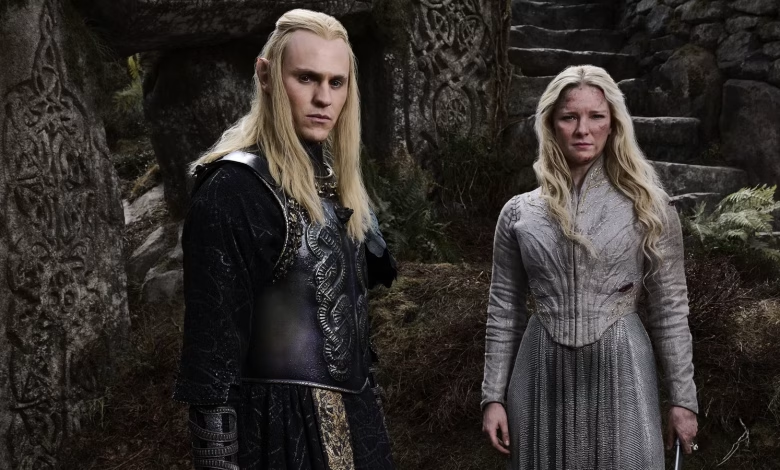
Sauron’s Plan Has Only Just Begun in The Rings of Power
Image via Prime Video
According to The Lord of the Rings‘ timeline, Sauron forged the One Ring around the year S.A. 1600, once the other nineteen Rings of Power had been created. His goal was to take control of Middle-earth by using the One Ring to dominate the minds of the important individuals who wore the other Rings of Power. Contrary to popular belief, Sauron had not yet gifted the other Rings of Power to Men or Dwarves; they were all in the Elves’ possession at the time. Sauron’s plan backfired because the mental connection formed between the wearers of the Rings of Power allowed the Elves to sense his wicked intentions and remove them before it was too late. Only then did Sauron decide to try corrupting Men and Dwarves instead, so he attacked Eregion to reclaim the Rings of Power.
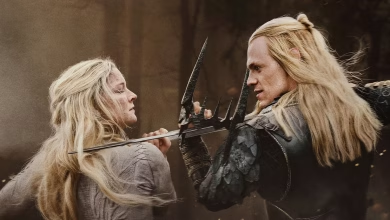
In Prime Video’s series, Sauron intended to give the Rings of Power to all three races from the start, and the writers have confirmed that a major focus of the third season will be Sauron distributing the Nine Rings among the race of Men, at which point he will presumably forge the One Ring to control them. As such, it is unlikely that the One Ring will be created any time soon in The Rings of Power, especially since Sauron will be busy waging war against the Elves and possibly gathering materials for the One Ring. The earliest it could feasibly happen is the Season 3 finale, but the Season 4 finale is more probable, because such a momentous occasion would be the perfect way to kick off the fifth and final season. The Downfall of Númenor, on the other hand, seems to be quickly approaching.
Númenor’s Destruction is Imminent in The Rings of Power
Image via Prime Video
Tolkien’s timeline placed Númenor’s end in S.A. 3319, nearly two millennia after the forging of the One Ring, and Sauron was deeply involved. Pharazôn saw the Dark Lord as a threat to his power, so he captured Sauron and imprisoned him in Númenor. This was all part of Sauron’s plan, as he was able to corrupt the Númenóreans from within. He made Pharazôn jealous of the Elves’ immortality and tricked him into believing that he could achieve eternal life by conquering the Undying Lands. When Pharazôn attempted to do so, he and his entire kingdom paid the price. In The Rings of Power, the corruption of Númenor is well underway. Pharazôn has already claimed absolute power and persecuted the Faithful who resist his rule. He also clearly envies the Elves, even hinting to Kemen that his eyes are set on the Undying Lands. The kingdom’s conflict has nearly come to a head, and it would be difficult to continue stretching out this storyline for multiple more seasons while waiting for Sauron to forge the One Ring. Removing the Dark Lord from the Downfall of Númenor would have a major consequence.
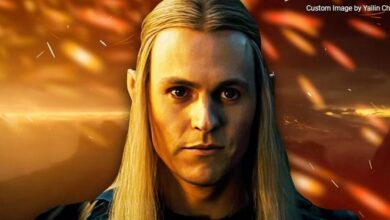
According to Tolkien, Sauron’s body was destroyed during the cataclysm. His immortal spirit persisted, and it was able to carry the One Ring to Middle-earth, where he formed a new body. However, because of the part he played in the Downfall of Númenor, his wickedness had become too great to conceal. In the section “Akallabêth,” Tolkien wrote, “He could never again appear fair to the eyes of Men… He wrought himself a new guise, an image of malice and hatred made visible; and the Eye of Sauron the Terrible few could endure.” Being unable to shapeshift into a fair form like Annatar hindered his ability to manipulate others, so he needed to either do so indirectly or work with similarly monstrous individuals who would not be concerned by his frightful appearance. It makes sense that The Rings of Power would do away with this aspect of Sauron’s story, because the series clearly wants the Dark Lord to be charming, even setting him up as a potential love interest for Galadriel. His monstrous form is one that he may choose of his own volition in The Rings of Power, long after both the forging of the One Ring and the Downfall of Númenor.