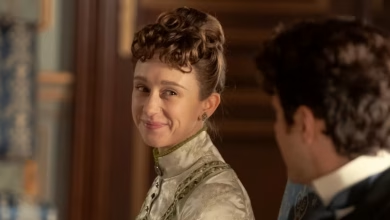
‘The Gilded Age’ Is No Longer a Show Where “Nothing Ever Happens,” Says Morgan Spector: “The Stakes Are Life or Death”

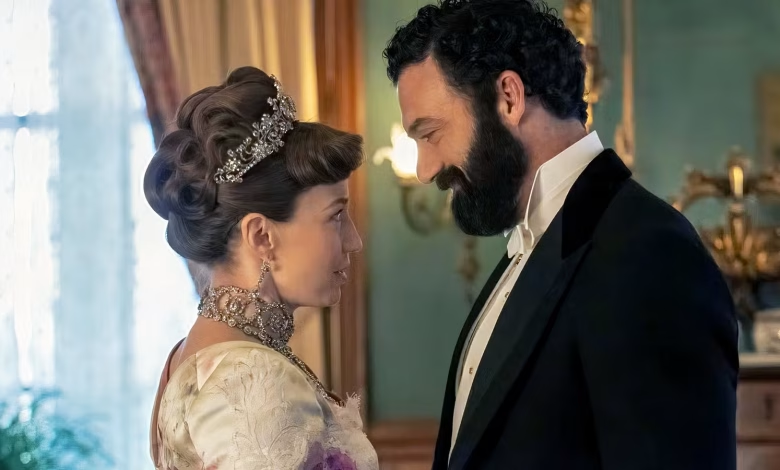
While George is ultimately saved by way of a risky operation on the Russells’ own dining room table, a place where his wife, Bertha (Carrie Coon), has hosted many an opulent meal, the couple’s future together is left unknown in the season’s very last scene. George, who still harbors regrets over insisting that their daughter, Gladys (Taissa Farmiga), marry a man she doesn’t love, finds it even more difficult to forgive Bertha for her role in orchestrating the match. It’s clear, in speaking with Spector now, even weeks removed from the Season 3 finale, that he has just as much love for the husband-and-wife pairing that has rapidly become a fan-favorite relationship on The Gilded Age — even if he has to remain tight-lipped about what the future holds.
COLLIDER: Season 3 is where The Gilded Age has started to push into decidedly darker territory. Now that the characters and the setting and this world have all been so established, it’s allowing the show to really break new narrative ground. I’m wondering if you felt the same when you were reading the scripts for Season 3 and saw where George and the Russell family’s story was going.
And that’s not the only thing. I think bringing in Phylicia Rashad to do a whole exploration of colorism inside the Black elite in Newport is also tricky, sophisticated, uncomfortable stuff. As you said, the show has established its characters, it’s established its world, and now it can really grow thornier branches, and it’s exciting. It’s harder to predict where we’re going to go over any subsequent seasons than it used to be.
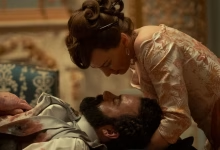
‘The Gilded Age’s Brutal Bertha/George Breakup Almost Doubled as the Series Finale
“It was out of filming order and all of those things, but it was [also] a way to potentially say goodbye to those characters in that scene if we had to.”

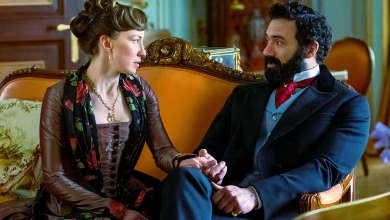
SPECTOR: For Bertha, the process you described has happened. She’s almost lost her husband, and it’s forced her to really reckon with what she would be losing if she did, and she doesn’t want him to go. She’s really realized what she wants; she needs to reinvest and figure out her relationship with him, and she thinks that’s happening. She thinks that process is underway. For George, it isn’t at all. What’s different between the two of them is that for Bertha, they’ve had a patch of bad communication, but ultimately, things have worked out. For George, he’s really failed his daughter. He thinks he’s a man of his word. He’s told his daughter he’s going to make sure she can marry for love, and he doesn’t do that. I can’t imagine that George has had too many failures in his history. He’s been a guy who’s moved from strength to strength and from victory to victory. I’m sure there were failures early on, but not as intimate and not as painful. That’s the thing he’s really reckoning with.
A lot of that had fallen away over the course of the third season, that George wasn’t really supporting Bertha’s ambition, and that he had suddenly become troubled by the way she was willing to sacrifice her family’s stability in order to achieve her various social goals, and so we wanted to circle back to some of those themes, and just touch, again, this mutual respect that they had for each other — even just to refer to it, even though it’s not really there in that scene. Like, “Yes, we did have an understanding, but you violated that.” It was out of filming order and all of those things, but it was [also] a way to potentially say goodbye to those characters in that scene if we had to.
We talked in Season 2 about the fan response to your character, to this marriage on screen, and the fervor with which people have really latched on to that relationship. Are you and Carrie still surprised by how much people are still rooting for these characters, and that you two have become a fan favorite in that regard?
I really have deep affection for this relationship. I care about it. I have always respected that Julian [Fellowes] and Sonja [Warfield] have chosen to write about, for the most part, up until this season, a relationship that works, trusting that even a relationship that works can be exciting and interesting and have a dynamic that makes it dramatically compelling. I think the audience connected to that because it is kind of a rarity. Often, we see marriages portrayed where one party is being quietly stifled. There’s stewing. I mean, that’s true. That’s realistic. People experience those kind of relationships, for sure. But there are also happy marriages, and they’re not all happy because the people have accepted some kind of banal, ordinary life. You can have ambition. You can have those things. I think that’s exciting for people to see.
It’s not like George and Bertha are this picture-perfect fantasy, either. We do see them having disagreements and reaching impasses in private moments when they’re together. Carrie is literally dressed down, with none of Bertha’s big outfits. It feels very vulnerable and intimate in a way that speaks to the realness of this marriage.
Also, they are set up as outsiders. No matter how much wealth and power they have in an absolute sense, relative to the society that they’ve been trying to enter, they are sort of despised people who don’t belong, and I think that’s part of the masterstroke. How those characters are drawn is that they’re both powerful and not accepted.
Morgan Spector Thinks ‘The Gilded Age’s Outspoken Cast Actually Helps the Show’s Popularity
“We want you to enjoy the show, but also we’re not unaware of its implications.”

SPECTOR: You don’t want to be making pro-billionaire propaganda, but I also think it is a pleasure to be in these luxurious worlds, and to be in these visually sumptuous spaces, and to engage with characters who have a lot of agency, who have a lot of power. It’s dramatically exciting. Whether it’s a mob boss or a powerful meth dealer or any number of things, we like to see people who have the capacity to do things on television. So, there’s something about that. Because I think in reality, in many of our lives, we don’t feel that we are free to act. We feel acted upon by a society that is very unequal in myriad ways. So, a fantasy that you can enter into, where you can imagine yourself as one of these characters who has tremendous freedom to act, I think that is really exciting.
Maybe this is totally wrong, but I have sort of been playing with this pet theory that the fact that there are so many outspoken leftists and progressives on our show makes it more enjoyable for the audience. It gives people permission. Obviously, some people are like, “I’m never watching that show again! I saw what Cynthia Nixon said about this.” I’ve seen that, and that’s whatever. But I also think that there are a lot of other people who see the problem of oligarchy in our society as a real political issue that needs to be addressed, to see wealth inequality in our society addressed.
In some ways, this is terrible. In some ways, you want to just be able to disappear into a fictional world and not think about who someone is in reality — and often, that happens, right? Often, something is able to just draw you in, and you forget about the real world. But sometimes, also just as often, you watch something, and you’re thinking of who this person is, what their story in public is, and you’re bringing that to bear on the fiction that you’re participating in. There’s this synergistic effect in terms of meaning, and I do think it’s actually helpful for our show that we have all these outspoken progressives talking about some of these issues of class and inequality publicly, while also helping to create this big, sumptuous, very unequal world.
SPECTOR: I miss it a lot. Some things have come up, and the truth is that I don’t live in the city anymore. I live a few hours away, and it weirdly makes it very difficult to do theater. Because if I’m in the city six days a week — I have a child in school up here in upstate New York — it means that my family, my whole support system, has to kind of reorient itself around me doing a play, and that’s a lot to ask of everyone in my life. My wife is very busy. She has her own career and her own things that she’s doing. So, it’s just a matter of logistics, really, that has kept me from doing it. But I’m hoping to do it again soon. I’m sort of thinking about something right now, actually, but we’ll see if I can make it happen.