The Gilded Age returns in 2026: historical events that are likely to appear in Season 4

HBO Max gave me the best Christmas present. Not only are we getting two new journeys back to Westeros, a documentary celebrating Mel Brooks’ centenary, and a generous slate of new series, but the platform has also moved up the return of the show I am utterly obsessed with: The Gilded Age. Yes, it officially appears in the 2026 lineup — breaking HBO’s usual strategy of giving its prestige franchises a two-year gap between seasons.

There may be several reasons behind this acceleration. Warner’s sale, imminent though likely to be finalized only toward the end of 2026; a programming gap that needs to be filled with something strong, or some specific contractual constraint. Speculating is a game I enjoy. Whatever the reason, recent cast interviews suddenly make much more sense, and those comments about scripts arriving soon were not wishful thinking. They were real.
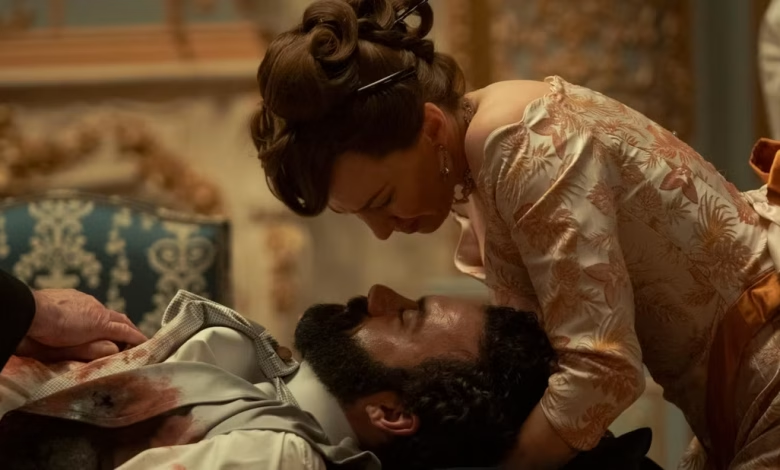
Of course, for now, almost nothing exists in terms of footage. The two frames that appear in the trailer come from the Newport ball, with Bertha Russell happily dancing with George. A curious — and even ironic — choice, considering the season ended with their separation: Bertha in tears in Newport, while George returns alone to New York, unaware that he is about to become a grandfather.
The general consensus among fans and observers is that there won’t be a major time jump. The story will likely move forward in only a few months. There are weddings to take place, babies to be born, and many loose ends to tie up. Among them:
– The marriage of Peggy Scott and Dr. Kirkland, and how they will balance two strong careers while dealing with the interference of the doctor’s mother, who is opposed to the union.

– The marriage of convenience between Oscar van Rhijn and Enid Turner-Winterton. They are already friends, but nothing could be more unsettling for Agnes than seeing her son marry a former lady’s maid, especially given how central that tension was in the first season. The coexistence of these two formidable women could prove unexpectedly productive… or explosive. Much will depend on how willing Agnes is to deceive herself about her son’s sexuality.
– Agnes’ growing involvement with the New York Heritage Society
.
– Larry and Marian: after the crisis that separated them, did they try to reconcile? Did they succeed? Are they engaged? Or have they learned to exist simply as friends?


– Who ordered George’s attempted murder? The answer seems obvious, but the investigation is still underway.
– Bertha and George: reconciliation or divorce?
– Jack, now wealthy: what will his next invention be — and whom will he marry?
Alongside these personal storylines, the series enters an extraordinarily rich historical moment. 1885–1886 is a turning point.

The Statue of Liberty arrived in New York Harbor in June 1885, dismantled into 214 crates, awaiting assembly on Bedloe’s Island. It is not yet a finished icon; it is a promise suspended in time. An entire city tries to convince itself that liberty and progress are shared experiences — when, in practice, they are not. It is hard to imagine this not making its way into the season.
The same is true of the completion of the Hotel Chelsea (1883–1885), a symbol of the city’s vertical ambition. New York is in motion: elevated trains, theaters like Wallack’s Theatre, cultural salons, and streets clogged by continuous immigration. Neighborhoods such as Five Points become epicenters of poverty, social tension, and humanitarian urgency.
All of this unfolds as the city emerges from the end of the Depression of 1882–1885, one of the most severe economic crises of the 19th century before the Great Depression. Growth returns, but it leaves deep scars. Prosperity is selective. Social wounds remain open. Debates about public health, housing, and urban reform stop being abstract and become unavoidable.
Some milestones broaden the show’s gaze beyond the white elite. In 1885, Sarah E. Goode became the first African-American woman to apply for and receive a U.S. patent, thanks to her invention of the hideaway bed — a folding bed designed for small, overcrowded apartments. This is not a technical footnote; it is a direct response to a New York that is growing upward while compressing inward, pushing Black and immigrant populations into ever-narrower margins.

The movement for women’s suffrage is also likely to gain greater prominence, especially given the involvement and support of Alva Vanderbilt, the real-life inspiration for Bertha Russell. By this point, the movement is already old, organized, and deeply politicized — not nascent, but persistent.
Finally, two clear signs of a world beginning to accelerate. In 1885, Karl Benz built the Patent-Motorwagen, the first automobile powered by an internal combustion engine. Still unstable and inaccessible, it remains a technological curiosity, but its logic is revolutionary: individual mobility, autonomy, speed without animal traction. The automobile was born as a promise — much like the Statue of Liberty, still dismantled in the harbor.
That same year, John Kemp Starley introduced the safety bicycle, the first modern bicycle. Affordable, practical, and transformative, it spreads rapidly, redefining urban mobility, leisure, and social customs — especially for women, who gain unprecedented freedom of movement. A democratic innovation in a profoundly unequal era.