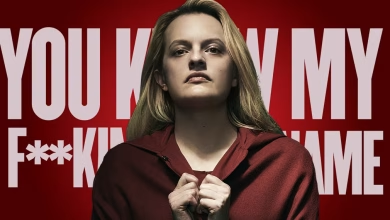
‘It Is So Easy To Fall Into Hopelessness’: Madeline Brewer On Janine’s Fate, ‘The Testaments’ And Why ‘The Handmaid’s Tale’ Still Matters

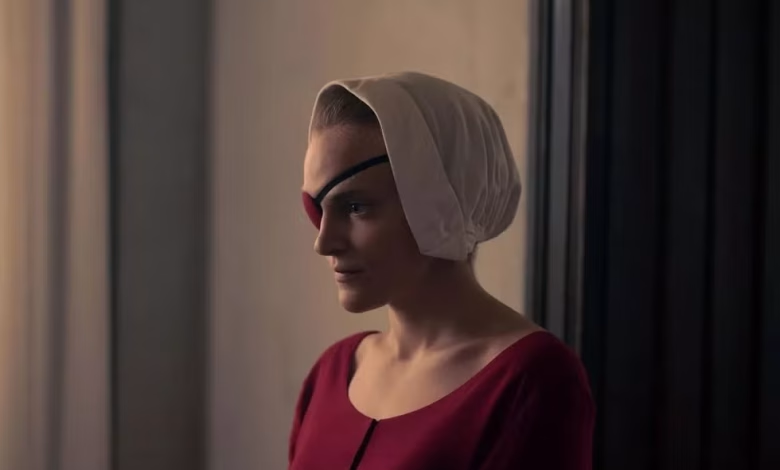
After nearly a decade of playing Janine, ‘The Handmaid’s Tale’ actor Madeline Brewer reflects on the emotional end of the show and what we can expect from ‘The Testaments’.
When filming for the first season of The Handmaid’s Tale began, the year was 2016. A year after that, when the second season premiered, Donald Trump had just been elected as President of the United States.
The timing wasn’t lost on both viewers and reviewers. Fast forward seven years and we’re now watching the last-ever season of Margaret Atwood’s dystopian tale against a backdrop of Trump back in the White House and a new sense of political and socio-economic chaos.
For the cast members who have lived with their characters throughout this period, Madeline Brewer, who has portrayed Janine since the first season, recalls a resounding sense of unity amid the uncertain times. ‘It’s rare to spend nine years with a character as an actor. You grow with a character, learn about them and learn about yourself and we’ve seen countless proposals, marriages and babies over the course of the show, we’ve all changed,’ she tells ELLE UK.
By the time filming for the final season came around, Brewer couldn’t deny the bleakness of working on the show alongside watching the 2024 Presidential election: ‘We were filming in Canada at the time, and it evoked this general sense of hopelessness, you kind of can’t escape it.’


Despite being a work of fiction, much of The Handmaid’s Tale deeply mirrors what we see in society today. Set against a scene of dark political times, in a fictionalised Republic of Gilead, a totalitarian regime that has overthrown the US government, women are forced into subservient roles based on their reproductive capacity, and citizens are governed by censorship, strict control and hierarchical social structures. 32-year-old New Jersey-born Brewer portrays one of the many Handmaids forcibly living in Gilead — her character, a young woman who often struggles with fluctuating mental health, has been a central supporting role throughout the series.
Contemplating the current global political climate, Brewer asks: ‘It makes you wonder if anything has changed. Have things gotten worse?’
It’s easy to understand why many feel as though the show’s themes are alarmingly timely, with the rise of authoritarianism across the world, the regression of women’s reproductive with the reversal of Roe vs. Wade and a growing gender divide in British politics.
Why The Handmaid’s Tale Still Has A Place In TV Today
While some believe that The Handmaid’s Tale has run its course, citing the brutal depictions of women’s suffering in Gilead as overwhelming, Brewer disagrees. ‘This is a show that celebrates the importance of community [in difficult times]. These women organise with each other, they have a network, they’re supportive, they have each other’s backs. Some of them pick up the slack when others aren’t able to fully meet them there, and that’s how a revolution starts this season,’ she says.
‘We’ve lost that today, we’re a hyper individualistic society. Having community, knowing your neighbours means that we can pick up each other’s slack. When one person’s feeling really beaten and really defeated, we can pick up that energy for each other. That’s why we need community, and community can look like a lot of different things. Whether it’s grassroots organising, voting in your local elections, being a supportive friend and showing up for each other, that’s how we stay, that’s how we connected. The Handmaid’s Tale is a great case of this, despite it being a fictionalised situation, the sentiment is still the same.’
Brewer’s understanding of the importance of community is a reminder in an era when many, feeling overwhelmed by the weight of daily life, are turning to escapism. As she puts it: ‘I think it is really intoxicating to want to just check out,’ and isn’t that the truth?
Yet Brewer believes this need for escapism shouldn’t overshadow the essential need for connection and community as highlighted in The Handmaid’s Tale.
Season Six Of The Handmaid’s Tale
As for Janine’s return in season six, she has survived the events of season five and is now working in Jezebels, one of the many Gileadean brothels.
‘Stepping back in Janine’s character felt like coming home a little bit’, describes Brewer. ‘In seasons one and two and three, I often found her really elusive, because she was like, not all there, but in seasons four, five, and especially in six, we are finding a much more grounded Janine, so she was a little easier to find, in terms of portraying her.’
Brewer’s understanding of the importance of community is a reminder in an era when many, feeling overwhelmed by the weight of daily life, are turning to escapism. As she puts it: ‘I think it is really intoxicating to want to just check out,’ and isn’t that the truth?
Yet Brewer believes this need for escapism shouldn’t overshadow the essential need for connection and community as highlighted in The Handmaid’s Tale.
Season Six Of The Handmaid’s Tale
As for Janine’s return in season six, she has survived the events of season five and is now working in Jezebels, one of the many Gileadean brothels.
‘Stepping back in Janine’s character felt like coming home a little bit’, describes Brewer. ‘In seasons one and two and three, I often found her really elusive, because she was like, not all there, but in seasons four, five, and especially in six, we are finding a much more grounded Janine, so she was a little easier to find, in terms of portraying her.’