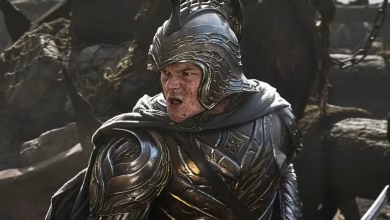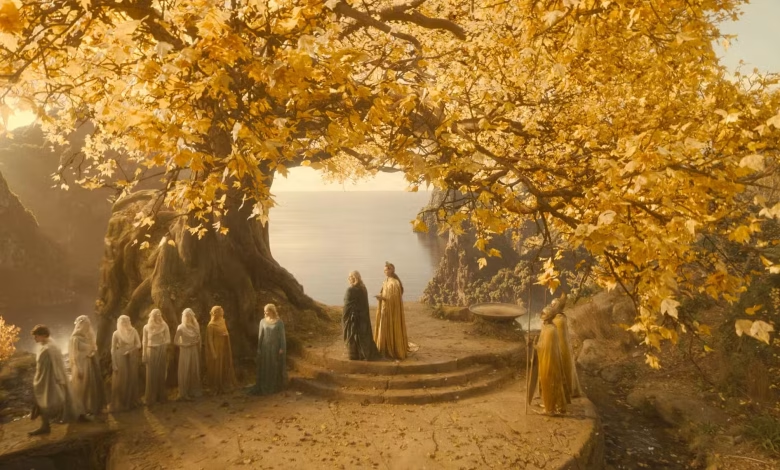
Gandalf’s confirmed presence during the Second Age – thousands of years before his documented arrival in established Middle-earth lore – though effective in freeing showrunners J.D. Payne and Patrick McKay to chart new storytelling territory in Tolkien’s world, places enormous pressure on the Gandalf character’s Season 3 deployment. Officially announced to jump forward in time to focus on the War of the Elves and Sauron, how Gandalf fits into this well-documented historical period and explaining how he gets scrubbed from historical records documenting the period, will play a crucial part in determining the show’s continued credibility with its audience.
Official Rings of Power Season 3 Logline:
Jumping forward several years from the events of season 2, season 3 takes place at the height of the War of the Elves and Sauron, as the Dark Lord seeks to craft the One Ring that will give him the edge he needs to win the war and conquer all Middle-earth at last.
One Rings of Power Reveal Challenges and Changes Everything
Tolkien’s Original Gandalf Timeline Is Thousands of Years Apart From Amazon’s Version

Tolkien wrote in 1972:
We must assume that they [the Istari] were all Maiar…these Maiar were sent by the Valar at a crucial moment in the history of Middle Earth to enhance the resistance of the Elves of the West, waning in power, and the Men of the West, greatly outnumbered by those of the East and South. It may be seen that they were free each to do what they could in this mission; that they were not commanded or supposed to act together… and that each had different powers and… were chosen by the Valar with this in mind.
In his final writings before passing in 1973, Tolkien expanded the possibilities, pairing Gandalf with Glorfindel—a significant character from the Second Age.
[Glorfindel] then became again a living incarnate person, but was permitted to dwell in the Blessed Realm; for he had regained the primitive innocence and grace of the Eldar… At some time, probably early in his sojourn in Valinor, he became a follower, and a friend, of Olórin (Gandalf), who as is said in The Silmarillion had an especial love and concern for the Children of Eru. That Olórin, as was possible for one of the Maiar, had already visited Middle-earth and had become acquainted not only with the Sindarin Elves and others deeper in Middle-earth, but also with Men, is likely, but nothing has yet been said of this.
Gandalf having walked Middle-earth before the Istari were sent would make his Second Age appearance in Rings of Power less bombastic. But since Amazon doesn’t have the rights to these source materials, like Unfinished Tales and The Peoples of Middle-earth, this part of Gandalf’s story is technically off-limits. That means no direct mentions of him in the Second Age, no ties to Glorfindel, and no deeper exploration of what he might have already understood about Sauron before the fight even began. It’s a gap that leaves space for creative interpretation, but also keeps some of Tolkien’s most compelling ideas out of reach.
Season 3’s High-Stakes Setting Poses Questions About Gandalf’s Presence
The War of the Elves and Sauron Will Likely Force Gandalf to Take Action

| Key Question | Implication |
|---|---|
| How does Gandalf’s proactive role in the Second Age contrast with his Third Age approach? | A philosophical shift between the second and third ages; patience to direct intervention. |
| Does Gandalf witness the creation of the Ringwraiths? | If he does, it creates inconsistencies with his apparent lack of knowledge about them in the Third Age. |
| What does this reimagining say about heroism in Tolkien’s work? | If Gandalf is active during this period, his failure to stop Sauron raises questions about his influence and effectiveness against the Dark Lord. |
The Lord of the Rings Lore Exploration Has Economic Ramifications
The Precarious Context of Gandalf’s Second-Age Arrival
Amazon’s investment in The Lord of the Rings and Rings of Power flirts totals about a billion dollars. Subsequently, any creative decision or deployment of a fan-favorite character inherently takes on dual responsibilities. Any story McKay and Payne present must be mindfully conjured, balancing their own artistic expression and strategic necessity. In turn, Gandalf’s emergence becomes a business-minded means of connecting the Rings of Power audience to Tolkien’s familiar faces and themes, an act of sleight of hand in hopes folks buy into its largely uncharted Second Age story.
| Season | Premiere Date | Viewership (First 4 Days) | Total Minutes Watched | Percentage Change from Season 1 |
|---|---|---|---|---|
| Season 1 | September 1, 2022 | 4 million | 100 million (est.) | N/A |
| Season 2 | April 19, 2024 | 3.5 million (estimated) | 40 million | -60% |
Legacy or Letdown? The Stakes Are High For Gandalf in Rings of Power Season 3
Shall This Gandalf Pass?

At its core, Gandalf’s presence in the highly anticipated Season 3 of Rings of Power is both exciting and anxiety-inducing. The conflict of the Second Age, marked by the War of the Elves against Sauron, has long been influenced by the absence of the Istari. Now, McKay and Payne have the opportunity to establish their series as a respected part of the rich legacy of Lord of the Rings adaptations, reshaping how fans view these pivotal characters and events.
Amazon’s Lord of the Rings series has changed canon and time-skipped. Now its livelihood may rest on one iconic character’s deployment.